

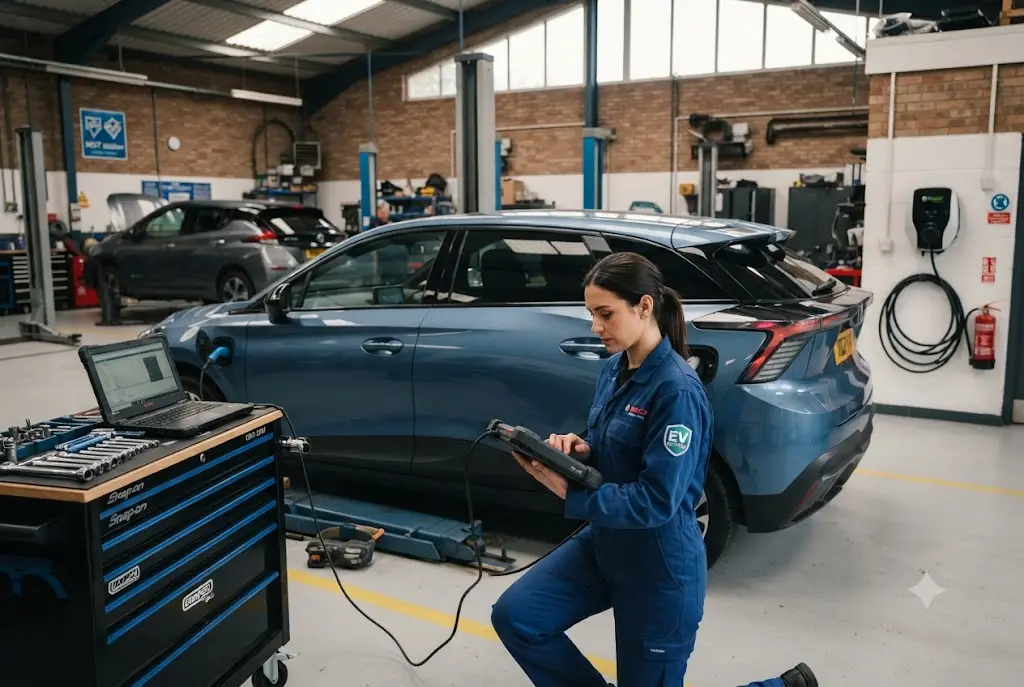
EV servicing is an important part of owning an electric family car in the UK. Although fully electric vehicles have fewer conventional engine components than petrol or diesel cars, they still need regular checks and maintenance. Tyres, brakes, suspension, steering, lights, cooling systems and electrical components all need appropriate attention throughout the vehicle’s life.
For families, an electric vehicle can become part of everyday life, from school runs and commuting to shopping, weekend journeys and longer holidays. Understanding what maintenance an EV needs can make ownership easier and help you choose a suitable garage before a problem develops.
Electric vehicles also introduce high-voltage systems that are different from those found in conventional cars. This means the workshop’s knowledge and equipment matter, particularly when work involves the high-voltage battery or associated electrical components.
What Does EV Servicing Include?
There is no single servicing schedule that applies to every electric vehicle. Manufacturers set their own maintenance requirements, so owners should always check the handbook and official service information for their specific model.
Depending on the vehicle and service interval, an EV inspection can include:
- Tyre condition and pressure checks
- Brake inspection
- Steering and suspension checks
- Lights and visibility equipment
- Windscreen washers and wipers
- Vehicle diagnostics
- Cooling-system checks where applicable
- High-voltage system inspections where required
- Battery-related checks where specified by the manufacturer
- Inspection of charging equipment and connections where relevant
Unlike a conventional petrol or diesel car, a fully electric vehicle does not require engine oil or an oil filter change. However, that does not mean it is maintenance-free.
Why EV Servicing Matters for Families
Families often depend heavily on one or more vehicles. A fault that might be inconvenient for an occasional driver can become a major disruption when the car is needed every day.
Regular maintenance provides an opportunity to identify worn tyres, brake problems, suspension issues and other faults before they become more serious.
Electric vehicles also use high-voltage electrical systems. The Health and Safety Executive explains that EVs and hybrids can contain high-voltage components and cabling capable of causing serious electric shock, while repair work may require additional skills, training, specialist tools and equipment. HSE guidance on electric and hybrid vehicles provides specific information for the motor vehicle repair industry.
That makes workshop suitability particularly important when choosing an EV mechanic.
EV Servicing vs Conventional Car Servicing
The maintenance routine for an electric vehicle is different from that of a conventional car, but many basic safety checks remain familiar.
An EV has no conventional engine, exhaust system or engine oil to maintain. It does, however, still have tyres, brakes, suspension, steering components, lights and other systems that can wear over time.
There can also be additional electrical components and thermal-management systems associated with the battery and electric drivetrain.
The result is not necessarily less maintenance overall. Instead, the type of maintenance changes.
EV Mechanics and High-Voltage Safety
Choosing suitable EV mechanics is particularly important when the required work involves the vehicle’s high-voltage system.
The HSE categorises work on electric and hybrid vehicles according to the level of risk and competence required. Routine maintenance that does not involve high-voltage electrical systems is different from work directly on high-voltage systems.
For high-voltage electrical work, technicians need appropriate competence, equipment and procedures. HSE guidance states that high-voltage systems should be isolated and tested to confirm they are safe before relevant work is undertaken.
As a vehicle owner, you do not need to carry out these procedures yourself. The practical lesson is to make sure the workshop you choose is appropriately equipped and trained for the work you are requesting.
Do EVs Need Regular Maintenance?
Yes. Even though an electric vehicle has fewer moving powertrain components, regular maintenance remains important.
Tyres are a particularly important consideration. Electric vehicles can be relatively heavy because of their battery packs, and tyre condition directly affects grip, braking and handling.
Brake systems also require attention. Regenerative braking can contribute to slowing the vehicle, reducing the use of conventional friction brakes in certain driving conditions. Nevertheless, brake components still need appropriate inspection and maintenance.
Suspension and steering systems also remain essential. If the vehicle develops unusual noises, vibration, pulling or uneven tyre wear, it should be checked rather than waiting for the next scheduled service.
EV Battery Servicing and Battery Care
The high-voltage battery is one of the most significant components in an EV, and owners naturally want to protect its condition.
Battery technology varies considerably between manufacturers and models. Charging recommendations, battery-management systems, warranty terms and thermal-management arrangements can all differ.
For that reason, generic advice should never replace the manufacturer’s instructions.
Some EVs can provide battery-health information through their onboard systems or manufacturer services. A qualified workshop may also have diagnostic equipment capable of assessing relevant battery-system information.
It is useful to keep records of servicing, repairs and any battery-related inspections. These records can help you understand the vehicle’s maintenance history and may be useful when discussing future work.
How to Look After an EV Battery
Battery care is not simply about avoiding a particular charging method. Owners should follow the manufacturer’s recommendations for charging, storage and vehicle use.
For everyday family driving, sensible habits can include:
- Following the manufacturer’s charging guidance
- Using the recommended charging equipment
- Paying attention to battery or charging warnings
- Keeping the vehicle within its recommended operating conditions
- Using scheduled charging features where appropriate
- Having unusual battery behaviour checked promptly
If your vehicle is regularly used for long journeys, understanding its charging requirements before travelling can also reduce unnecessary stress.
EV Charging Support for Family Ownership
Charging is one of the biggest practical differences between an electric car and a conventional family vehicle.
Before buying or relying heavily on an EV, consider where the vehicle will normally be charged. Home charging can be particularly convenient for families because the vehicle can be replenished while parked overnight.
Public charging can provide additional flexibility for longer journeys, but availability, charging speeds and costs vary between locations and networks.
It is also useful to understand your vehicle’s charging connector, maximum charging capability and the difference between slower and faster charging options.
A garage may not be responsible for installing your home charger, but a workshop familiar with EVs can still be useful when diagnosing charging-related vehicle faults.
What If Your EV Will Not Charge?
A charging problem does not automatically mean the high-voltage battery has failed.
Potential causes can include the charging cable, charging equipment, vehicle settings, communication between the car and charger, electrical supply or a fault within the vehicle.
If a problem occurs, check the vehicle’s charging instructions and any displayed warning messages. If the issue continues, a suitably equipped EV workshop can diagnose the vehicle.
Avoid attempting to dismantle or repair high-voltage components yourself. The HSE highlights the specific risks associated with high-voltage systems and recommends appropriate competence and equipment for people working on them.
Choosing EV Garages in the UK
Not every garage will offer the same level of EV capability. Before booking, ask practical questions about the workshop’s experience.
- Does the garage regularly work on electric vehicles?
- Are technicians trained to work safely on EV systems?
- Can the workshop perform the service required for your model?
- Does it have suitable diagnostic equipment?
- Can it handle high-voltage work if necessary?
- Can it diagnose charging-related faults?
- Will the garage explain additional repairs before carrying them out?
If you are comparing several workshops, our garage comparison guide can help you assess customer reviews, technical capability, pricing and convenience.
EV Servicing for Different Family Needs
Not every family uses an EV in the same way. A vehicle used mainly for short school runs may have different maintenance considerations from one regularly driven on motorways.
Short Daily Journeys
Frequent short trips can make tyre condition, brake condition and general inspections important. Do not assume low mileage means the vehicle can be ignored between service intervals.
High-Mileage Family Driving
Families covering substantial mileage should pay close attention to tyre wear, brake condition and the manufacturer’s service schedule. More frequent use can also make preventative maintenance particularly valuable.
Long-Distance Trips
Before a holiday or long journey, check tyre pressures, tyre condition, warning messages and charging plans. It is sensible to know where charging stops are likely to be available rather than relying entirely on finding a charger at the last minute.
Tyres, Wheel Alignment and EV Handling
Tyre maintenance deserves special attention on an electric family car. Incorrect pressure, uneven wear or damaged tyres can affect handling and efficiency.
If the vehicle pulls to one side, the steering wheel appears off-centre or tyre wear is uneven, ask a qualified workshop to investigate.
Our guide to wheel alignment explains how steering alignment and related checks can help address handling concerns and uneven tyre wear.
A garage should diagnose the underlying cause rather than simply replacing tyres without investigating why unusual wear has occurred.
Brake Maintenance on Electric Cars
Regenerative braking changes how the vehicle slows down, but conventional brake components are still part of the car.
Brake discs and pads may experience different usage patterns compared with a conventional vehicle. That does not eliminate the need for inspections.
If you notice unusual noises, vibration, changes in braking performance or warning messages, arrange an inspection rather than waiting for a scheduled service.
EV Ownership Costs and Maintenance
Electric vehicle ownership costs depend on the model, mileage, insurance, electricity costs, charging arrangements, tyres, servicing and repairs.
It is therefore better to avoid broad claims that every EV will automatically be cheaper to maintain than a petrol or diesel car.
Instead, consider the vehicle as a complete ownership package. Fewer conventional drivetrain components can change the maintenance profile, while tyres, brakes, suspension, electrical systems and battery-related components remain important.
When comparing an EV with another family car, include the manufacturer’s service schedule and warranty terms in your calculations.
When Should an EV Be Serviced?
There is no universal EV servicing interval. Different manufacturers use different schedules, and some models may have maintenance requirements based on time, mileage or specific system checks.
The owner’s handbook should therefore be your primary reference.
If the vehicle displays a service reminder or warning message, do not ignore it simply because the car is electric. Regular maintenance remains part of responsible vehicle ownership.
Signs Your Electric Car Needs Attention
Families should arrange a professional inspection if an EV develops an unusual symptom, particularly when it affects safety or drivability.
Possible warning signs include:
- Unexpected warning lights
- Charging failures
- Sudden changes in vehicle performance
- Unusual noises or vibrations
- Steering problems
- Uneven tyre wear
- Brake-related changes
- Unusual battery behaviour
- Repeated charging interruptions
Do not assume that every warning indicates a serious battery fault. Proper diagnostics can identify the actual cause.
EV Servicing After an Accident
Accident damage can require particular care on an electric vehicle because the high-voltage battery and associated electrical components may be affected.
The HSE advises that damaged electric and hybrid vehicles should be assessed for signs of damage to high-voltage components or cabling and that manufacturer-specific information should be used when dealing with these systems.
If an EV has suffered significant collision damage, use an appropriate repair or recovery service rather than treating it exactly like a conventional car.
This is particularly important when damage has occurred near the underside of the vehicle or battery area.
How Families Can Prepare for EV Servicing
A little preparation can make a garage appointment more efficient.
- Check your service schedule before booking.
- Record any warning messages or unusual symptoms.
- Tell the garage about charging problems.
- Provide details of recent repairs or accidents.
- Ask whether the workshop has experience with your specific model.
- Confirm what the quoted service includes.
- Ask before approving additional work.
- Keep the invoice and service record afterwards.
These steps can help the technician understand the vehicle’s history and reduce unnecessary diagnostic delays.
EV Servicing Checklist for UK Families
Before choosing an EV workshop, check:
- EV-specific technical experience
- Appropriate technician training
- Suitable diagnostic equipment
- Ability to handle the required service
- High-voltage capability where necessary
- Clear pricing
- Good recent customer feedback
- Convenient location and appointment times
- Clear documentation after the work
If your family owns both an EV and a hybrid, it can be useful to compare their maintenance requirements. Our guide to hybrid servicing covers the different considerations involved in maintaining a hybrid vehicle.
Final Thoughts on EV Servicing
EV servicing is an essential part of responsible electric-car ownership. While EVs eliminate many conventional engine-related maintenance tasks, they still require regular attention to tyres, brakes, steering, suspension, electrical systems and other safety-critical components.
The most important difference is the presence of high-voltage systems. When work involves the battery or other high-voltage components, the garage should have the appropriate training, equipment and procedures.
For families, the best approach is straightforward: follow the manufacturer’s maintenance schedule, monitor the vehicle between services, take charging or warning problems seriously and choose an EV-capable workshop when specialist work is required.
With the right maintenance routine, an electric vehicle can become a practical and dependable part of everyday family transport.
For official information about safe work on electric and hybrid vehicles, consult the Health and Safety Executive’s electric and hybrid vehicle guidance.
